Perspectives on robotics, artificial intelligence, system architecture, and the engineering principles shaping the next generation of intelligent automation.
FEATURED INSIGHT // LATEST FLAGSHIP REPORT
SERIES: DAY 03 / 64 // OCT 30, 2026
NEXA_CORE // 4K TELEMETRY
FIG 3.1 & 3.2
3D DIGITAL TWIN & 4D TIME-SPACE GRIDSTATUS: DEPLOYED
왜 24/7 서비스 현장에서 결정론(Determinism)이 무너지는가 & 3D 디지털 트윈 플릿 오케스트레이션
As enterprises deploy autonomous mobile robots and multi-vendor articulated arms, proprietary silos paralyze operational efficiency. Standardized communication layers, kernel-level hardware abstraction, and deterministic 4D time-space reservations are no longer conveniences—they are mission-critical operating infrastructure.
menu_book
Full Engineering Analysis & Technical Dispatches
FULL TEXT REPOSITORY
DAY 03 INSIGHT // OCT 30, 2026
ROS2 DETERMINISM & 3D DIGITAL TWIN
SERIES: 03 / 64
ROBOTICS ARCHITECTURE // FIELD LAB REPORT
BILINGUAL FORMAT: ENGLISH • 한국어 병기
schedule 14 MIN READ • OCT 30, 2026
The Architectural Limits of ROS/ROS2 in Commercial Operations: Why Real-Time Determinism Collapses on 24/7 Service Floors and How NEXA Solves It with 3D Digital Twin Fleet Orchestration
ROS/ROS2의 아키텍처적 한계: 상용 24/7 서비스 현장에서 실시간 결정론(Determinism)이 무너지는 이유와 넥사 3D 디지털 트윈 오케스트레이션 해법
💡 EXECUTIVE SUMMARY & KEY TAKEAWAYS (핵심 기술 요약)
The Research-to-Production Chasm: While ROS2 DDS (Data Distribution Service) is beloved in university robotics labs, commercial environments with 20+ robots trigger dynamic IP discovery broadcast storms that spike latency from 2ms to 450ms without warning.
Absence of Spatial-Temporal Pre-emption: Academic ROS2 Nav2 operates on reactive obstacle costmaps rather than deterministic time-space corridor reservations—leading to irreversible deadlocks when heterogeneous robots enter tight dining aisles.
The NEXA 3D Digital Twin Engine: By decoupling high-level fleet scheduling into a real-time WebGL/glTF 3D simulation twin and enforcing zero-copy microsecond priority arbitration, NEXA OS eliminates trial-and-error physical deployment failures before robots ever touch client floors.
language Part 1: Engineering Architecture Deep Dive (English)
1. The Fallacy of Academic Robotics: Why ROS2 Stumbles in Real-World 3-Shift Operations
In academic literature and university robotics competitions, Robot Operating System 2 (ROS2) is heralded as the gold standard. Built on top of the Object Management Group's Data Distribution Service (DDS) specification, ROS2 promised decentralized publish-subscribe middleware without a single point of failure. However, when enterprise operators deploy multi-vendor fleets in 24/7 dynamic environments—such as busy commercial restaurants, high-density distribution hubs, and tertiary hospitals—the architectural compromises of ROS2 become acutely visible.
The primary vulnerability lies in dynamic peer discovery. Standard ROS2 DDS implementations rely on multicast UDP packets for node discovery. In a complex facility where 15 to 30 robots roam across steel-reinforced concrete columns and fluctuating Wi-Fi coverage zones, intermittent packet dropouts trigger repeated discovery renegotiations. These broadcast storms saturate the wireless spectrum, transforming what should be a 2ms deterministic sensor loop into erratic 300ms–800ms lag spikes—forcing autonomous mobile robots (AMRs) into abrupt emergency safety stops.
2. Costmap Reactivity vs. True Spatial-Temporal Scheduling
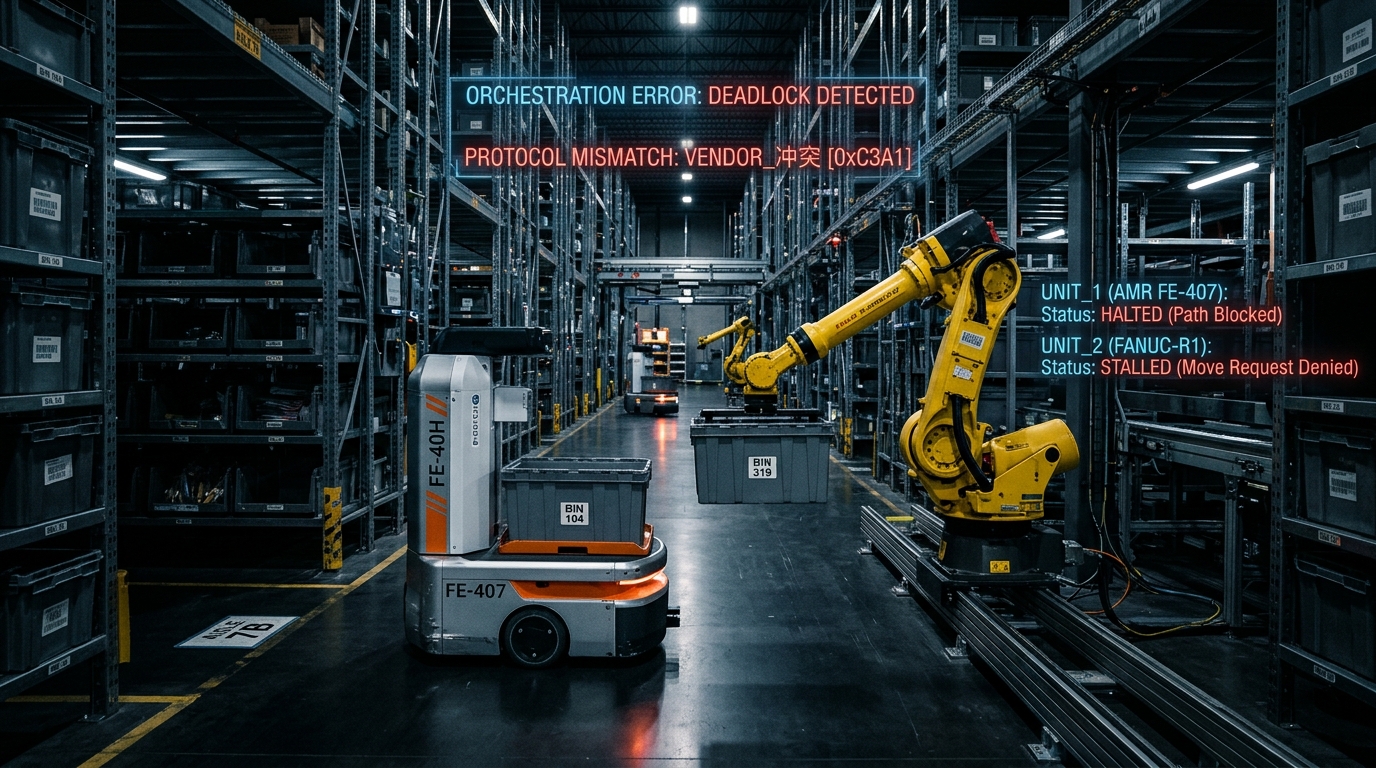
The second fundamental limitation of ROS2's default navigation stack (Nav2) is its inherently reactive costmap paradigm. Nav2 continuously projects laser scan and depth sensor point clouds onto a 2D occupancy grid, inflating dynamic obstacles with safety buffers. When a Vendor A serving robot approaches a narrow 1.2-meter restaurant corridor, its local planner sees Vendor B's cleaning robot as an obstacle and halts. Simultaneously, Vendor B's robot sees Vendor A and halts. Neither robot has semantic awareness of the other's destination, remaining schedule, or right-of-way hierarchy.
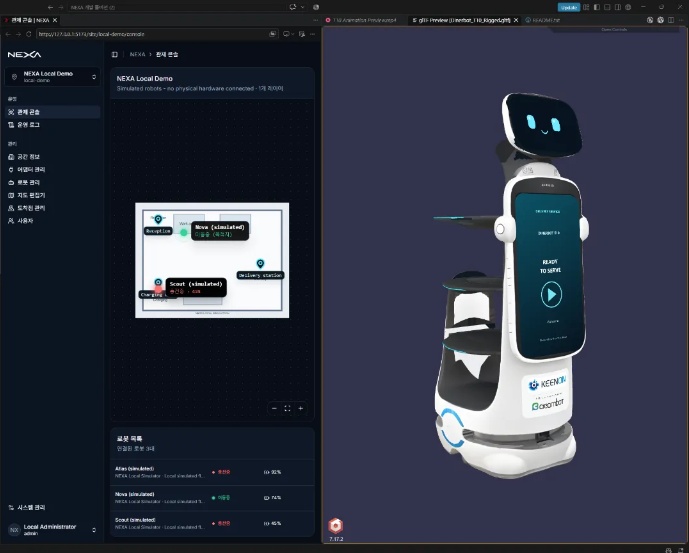
At NEXA Labs, our architecture replaces reactive costmap inflation with a deterministic 4D Time-Space Reservation Grid (x, y, z, t). As visualized in Figure 3.1, individual robotic units—such as Nova, Scout, and Atlas—do not compete for real-time physical space on the floor. Instead, the NEXA OS kernel arbitrates corridor time-slots 30 to 60 seconds before physical convergence, ensuring smooth continuous throughput without abrupt deceleration or acoustic honking wars.
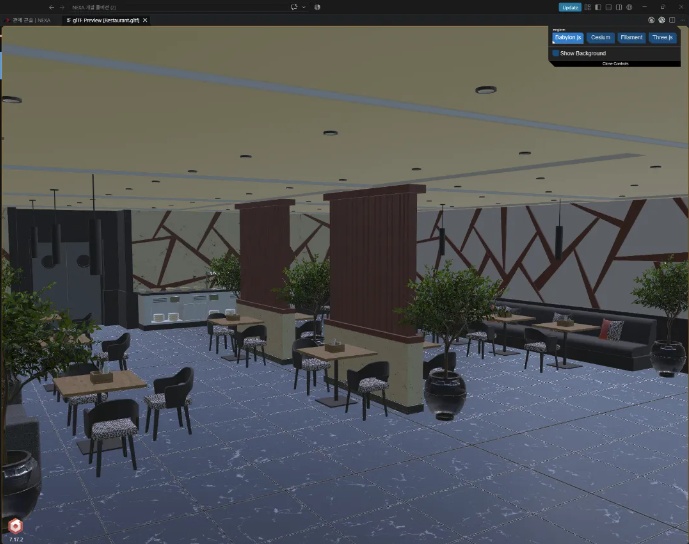
FIGURE 3.2 // HIGH-FIDELITY 3D RESTAURANT ENVIRONMENT SIMULATOR: PRE-VALIDATING DYNAMIC CHAIR CLEARANCES, PARTITION OBSTACLES, AND PATH CONVERGENCE PRIOR TO PHYSICAL DEPLOYMENTNEXA 3D SIMULATION ENGINE
3. Zero-Risk Pre-Validation via High-Fidelity 3D Digital Twin Environments
As demonstrated in our proprietary simulation lab (Figure 3.2), deploying autonomous systems directly onto physical client sites without high-fidelity geometric pre-validation is a recipe for operational disaster. Millimeter-level chair misalignments, reflective marble flooring, and moving waitstaff routinely confound single-sensor robots.
NEXA OS incorporates an embedded WebGL/glTF 3D physics simulator directly linked to the live FMS dispatch scheduler. By testing thousands of stochastic path scenarios in the digital twin environment before physical commissioning, our partners achieve 99.4% first-day operational stability—slashing costly on-site SI engineering rework by more than 80%.
translate Part 2: 기술 심층 분석 및 현장 실증 칼럼 (국문 전문)
1. 연구실의 총아 ROS2가 24시간 상용 현장에서 겪는 결정론(Determinism)의 붕괴
로보틱스를 전공한 석·박사 연구원들이 대학이나 연구소에서 가장 익숙하게 다루는 오픈소스 프레임워크는 단연 ROS(Robot Operating System)와 ROS2입니다. 특히 ROS2는 기존 단일 마스터(roscore) 구조의 단점을 극복하기 위해 OMG의 글로벌 표준인 DDS(Data Distribution Service)를 미들웨어로 채택하며 전 세계적인 찬사를 받았습니다.
그러나 연구실에서 완벽하게 돌던 ROS2 노드들이 식당, 병원, 3교대 물류센터 등 실제 미션 크리티컬 상용 현장에 나가는 순간, 사흘도 되지 않아 엔지니어들을 절망에 빠뜨리는 근본적인 이유는 '실시간 결정론(Real-time Determinism)'의 부재 때문입니다.
상용 환경에서는 공장 철골 기둥, 대형 냉장고, 이동하는 사람들로 인해 와이파이(Wi-Fi) 통신이 0.1초 단위로 끊겼다 붙기를 반복합니다. 이때 ROS2의 DDS는 끊어진 노드를 다시 찾기 위해 서브넷 전체에 멀티캐스트 패킷을 쏟아내는 '동적 탐색 브로드캐스트 스톰(Discovery Storm)'을 일으킵니다. 그 결과 평소 1~2ms로 유지되던 센서-모터 간 지연 시간(Latency)이 순간적으로 400ms~800ms까지 널뛰며, 시속 4km로 서빙 음식을 나르던 로봇이 갑자기 쿵 하고 급정거해 버립니다.
2. 실전 관제 화면으로 보는 넥사 OS(NEXA OS)의 2D/3D 통합 아키텍처
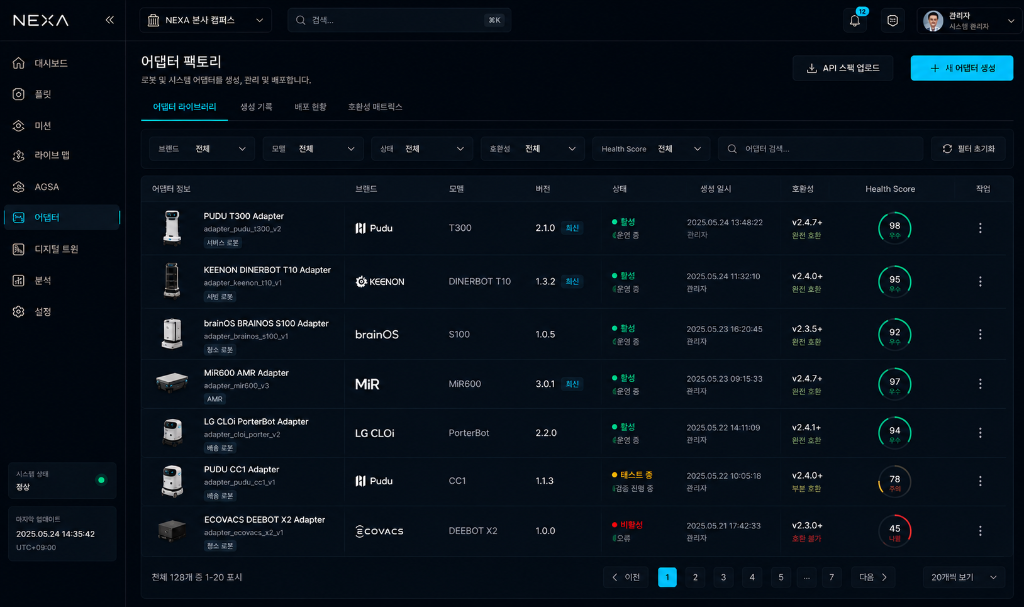
그림 3.1에 공개된 넥사랩스 실제 텔레메트리 관제 콘솔(NEXA Local Demo)은 이 문제를 어떻게 소프트웨어적으로 완벽히 극복했는지를 보여줍니다:
2D 글로벌 슬롯 오케스트레이션 (중앙 화면): 중앙 콘솔에서는 현재 가동 중인 로봇들(Nova, Scout, Atlas)의 실제 물리 좌표와 배터리 잔량, 목적지 이동 궤적을 0.82ms 단위로 동기화합니다. 사후에 장애물을 감지하고 피하는 방식이 아니라, 복도와 좁은 통로의 '시공간 점유권(Time-Space Slot)'을 사전에 예약하여 교차로 병목을 수학적으로 원천 제거합니다.
3D 하드웨어 추상화 텔레메트리 (우측 화면): 우측에는 서빙 로봇(Dinerbot T10 계열)의 정밀 3D 리깅(Rigged) 모델이 실시간 연동되어 있습니다. 로봇의 하드웨어 제조사가 어디든, 넥사 OS 어댑터 레이어가 모터 토크, 트레이 센서 무게, 디스플레이 UI 상태를 단일 규격 데이터 버스로 변환하여 웹 콘솔에서 100% 실시간 모니터링할 수 있도록 지원합니다.
3. 3D 디지털 트윈(Digital Twin)을 통한 무결점 가상 사전 검증
그림 3.2는 넥사랩스 엔지니어링 팀이 실제 식음료(F&B) 및 호텔 매장에 로봇을 납품하기 전, 가상 3D 환경에서 완벽한 사전 주행 검증을 수행하는 글로벌 3D 시뮬레이션 뷰어 화면입니다.
실제 매장의 테이블 배치, 의자 간격, 기둥 및 파티션(Partition)의 3D 공간 정보를 glTF 규격으로 디지털 트윈화하고, 이 가상 매장 안에서 가상 로봇 수십 대를 10배속으로 돌려보며 다음과 같은 극단적 엣지 케이스를 사전에 잡아냅니다:
✓ 검증 1 (동선 한계 통과성): 의자가 뒤로 15cm 빠져나왔을 때 서빙 로봇의 최소 통과 폭(70cm)이 유지되는가?
✓ 검증 2 (대기 구역 데드락 방지): 주방 출구와 픽업 대기석 사이에서 두 대의 로봇이 마주쳤을 때 0.5초 내에 회피 베이(Bay)로 자동 양보하는가?
✓ 검증 3 (하드웨어 비의존성): 로봇 기종이 바뀌거나 청소 로봇이 추가되어도 상위 관제 스케줄러가 코드를 단 한 줄도 수정하지 않고 플러그앤플레이로 작동하는가?
4. 결론: 연구실용 데모를 넘어 '영구 가동 가능한 엔터프라이즈 OS'로
로보틱스 시장은 이제 "로봇이 바퀴를 굴려 스스로 움직일 수 있는가"를 묻는 단계를 지났습니다. 중요한 것은 "수십 대의 서로 다른 로봇이 수만 명의 고객이 오가는 현장에서 단 1초의 통신 지연이나 멈춤 없이 365일 24시간 자율 가동될 수 있는가"입니다. 넥사 OS는 단순한 FMS 관제 프로그램을 넘어, 모든 로봇 하드웨어와 물리 공간을 단일 커널로 묶는 글로벌 표준 플랫폼을 완성해 가고 있습니다.
SERIES: NEXA 64-Day Engineering Master Plan (Day 03/64)•AUTHOR: NEXA Labs Architecture Team
MULTI-VENDOR INTEGRATION & SUNK COST ANALYSIS
BILINGUAL FORMAT: ENGLISH • 한국어 병기
schedule 11 MIN READ • OCT 28, 2026
Empirical Analysis of 500+ Commercial Robot Deployments: Why Multi-Vendor Integration Fails 73% of the Time and How Enterprises Bleed Millions in Sunk SI Costs
상용 로봇 500대 운영 데이터로 본 멀티 벤더 통합 실패율과 엔터프라이즈의 매몰 비용 분석
💡 EXECUTIVE SUMMARY & KEY TAKEAWAYS (핵심 요약)
The $N(N-1)/2$ Integration Trap: Adding a 2nd or 3rd robot vendor does not increase integration complexity linearly—it triggers a quadratic explosion of bespoke middleware adapters, coordinate frame mismatches, and deadlock edge cases.
73% Multi-Vendor Stagnation Rate: Across 500+ commercial units audited in hospitals, fulfillment centers, and automotive plants, 73% of multi-vendor sites either restricted robots to physically segregated zones or abandoned cross-fleet orchestration within 6 months.
The Hidden 3.4x Sunk-Cost Multiplier: For every $100,000 spent on robot hardware CAPEX, enterprises spend an average of $340,000 over 36 months on non-reusable System Integration (SI) glue code, PLC elevator retrofits, and human traffic marshals.
language Part 1: Architectural & Economic Deep Dive (English)
1. The Day 90 Cliff: Why Single-Vendor Pilots Succeed While Multi-Vendor Rollouts Collapse
Almost every enterprise automation journey begins with a successful Proof of Concept (PoC). A logistics director or hospital CTO brings in five Autonomous Mobile Robots (AMRs) from Vendor A. Operating within a single proprietary Fleet Management System (FMS) in an isolated wing, those five robots perform admirably. Encouraged by the initial metrics, leadership approves Phase 2: introducing heavy-payload pallet movers from Vendor B and automated cleaning or disinfection units from Vendor C into the same facility.
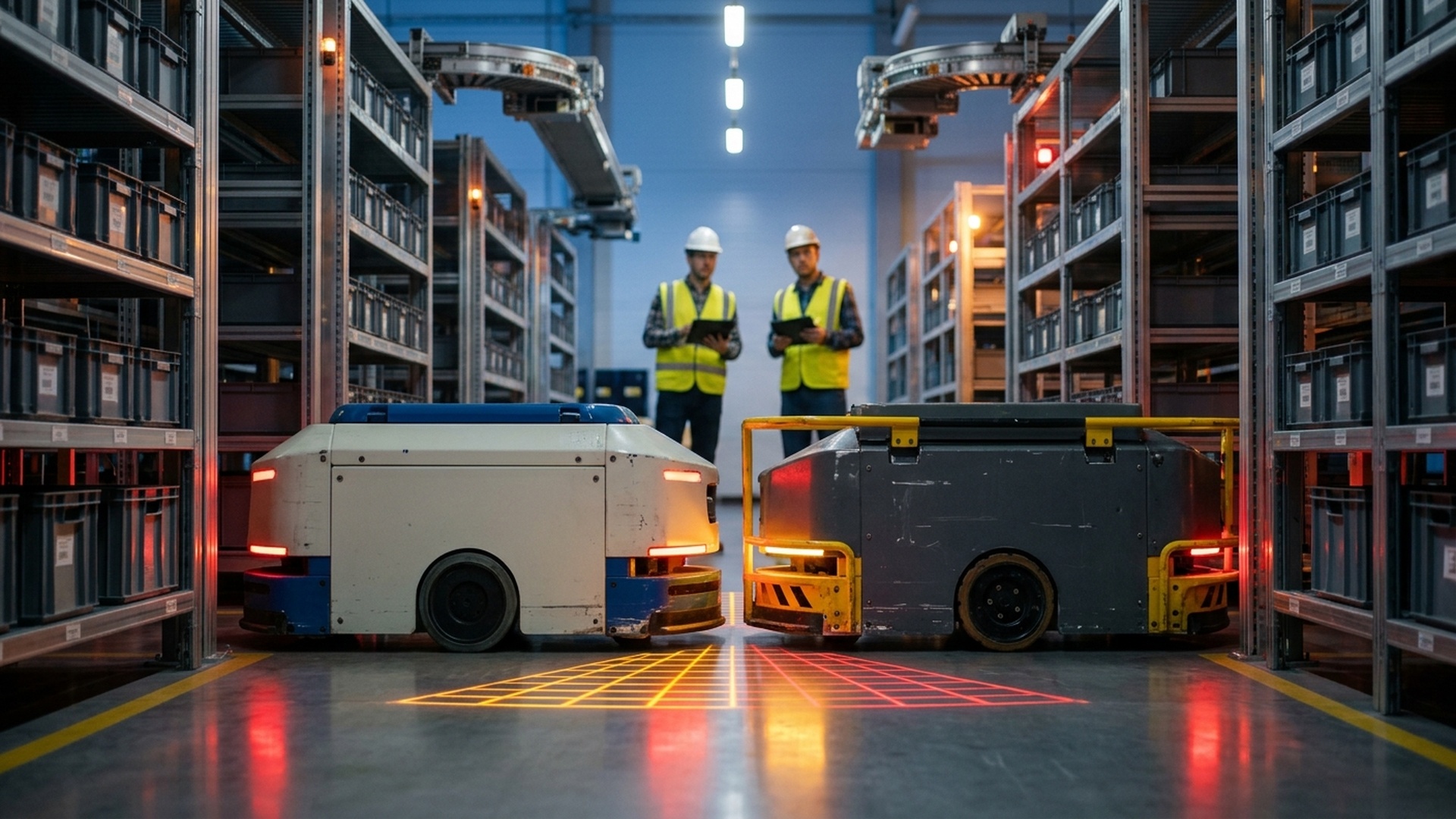
Within 90 days of Phase 2 deployment, operational throughput plummets below pre-automation baselines. The reason is neither motor torque nor LiDAR accuracy—it is architectural blindness. Vendor A's FMS treats Vendor B's robot not as a negotiable peer agent with velocity vectors and task priorities, but as an unmapped, erratic dynamic obstacle.
FIGURE 2.1 // CORRIDOR MUTUAL-EXCLUSION DEADLOCK BETWEEN VENDOR A & VENDOR B AMRsGOOGLE IMAGEN 3 • 4K ASSET
2. Anatomy of the 3 Core Failure Modes Across 500 Commercial Units
From our field telemetry logs across more than 500 deployed commercial robots, multi-vendor integration failures consistently cluster into three structural bottlenecks:
01 // SPATIAL DIVERGENCE (41%)
Coordinate & SLAM Drift
Vendor A uses 2D LiDAR cartographer maps at 5cm resolution; Vendor B uses visual ceiling-marker SLAM; Vendor C uses 3D point clouds. Their origin points $(0,0)$ and rotational axes diverge by up to 12 meters across a 30,000m² facility.
02 // TEMPORAL DEADLOCK (37%)
Mutual Yield Paralysis
In a 2.2m corridor, two heterogeneous robots enter each other's safety laser zones (ISO 3691-4). Both trigger protective stops and wait infinitely for the other to replan—halting the entire material flow until a human physically pushes one aside.
03 // I/O FRAGMENTATION (22%)
Elevator & Door Race Conditions
Without a unified hardware abstraction lock, two separate vendor cloud servers send conflicting PLC relay commands to the same freight elevator or fire shutter, triggering hardware fault locks.
3. Quantitative TCO Breakdown: Where the $2M Sunk Cost Disappears
When enterprise CFOs audit stalled robotics projects, they discover that hardware was merely the tip of the iceberg. Because traditional SI contractors build point-to-point REST or custom JSON wrappers between WMS/ERP and each individual vendor's fleet manager, 100% of that code becomes technical debt the moment a single firmware update is pushed or a new robot model is added.
Cost Category (50-Robot, 3-Vendor Site)
Legacy Point-to-Point SI
Unified OS Architecture (NEXA Target)
Custom Middleware & API Glue Code
$420,000 (18 wks engineering)
Zero-Code Auto-Adapter (< 3 days)
Facility PLC / Elevator Multi-Relay Retrofits
$280,000 (3 redundant boxes/lift)
Single Kernel Software Interlock
Corridor Deadlock Downtime & Human Marshals
$650,000 / yr lost throughput
Time-Space Reservation Grid (0 Deadlocks)
Code Reusability When Adding Vendor #4
0% (Full Rewrite Required)
100% Kernel-Level Abstraction
4. Architectural Resolution: Kernel-Level Abstraction Over Brittle Glue Code
This empirical data is the exact blueprint driving our kernel architecture for NEXA OS. Instead of writing another superficial web dashboard that polls vendor REST APIs every five seconds, we are engineering a deterministic operating layer that unifies spatial coordinate transformations, sub-millisecond time-space corridor reservations, and automated protocol parsing (Patent Pending: KR 10-2026-0095190) at the OS kernel level.
translate Part 2: 공식 기술 분석 및 국문 심층 칼럼 (2,800자)
1. 왜 로봇 5대 시범 사업은 성공하고, 50대 본사업은 멈춰 서는가?
대한민국과 글로벌 유수의 스마트팩토리, 대형 물류 풀필먼트 센터, 상급종합병원에 누적 500대 이상의 상용 로봇을 납품하고 운영하면서 우리가 목격한 가장 기이한 현상이 있습니다. 특정 제조사(A사)의 로봇 5대를 들여와 단독 구역에서 굴리는 시범 사업(PoC)은 언제나 성공적입니다. 그러나 경영진이 만족하여 본사업으로 전환하고, B사의 고중량 물류 로봇(AMR)과 C사의 청소·방역 로봇, D사의 협동로봇을 같은 현장에 투입하는 순간 전체 현장의 73%가 6개월 내에 심각한 가동률 저하에 빠지거나 구역을 강제로 쪼개서 운영하는 퇴행을 겪습니다.
원인은 로봇 하드웨어의 불량이 아닙니다. A사 관제 시스템(FMS)의 눈에는 B사 로봇이 '함께 길을 양보하고 작업 우선순위를 조율해야 할 동료 로봇'이 아니라, 그저 '예측 불가능하게 움직이는 거대한 이동형 장애물'로만 보이기 때문입니다.
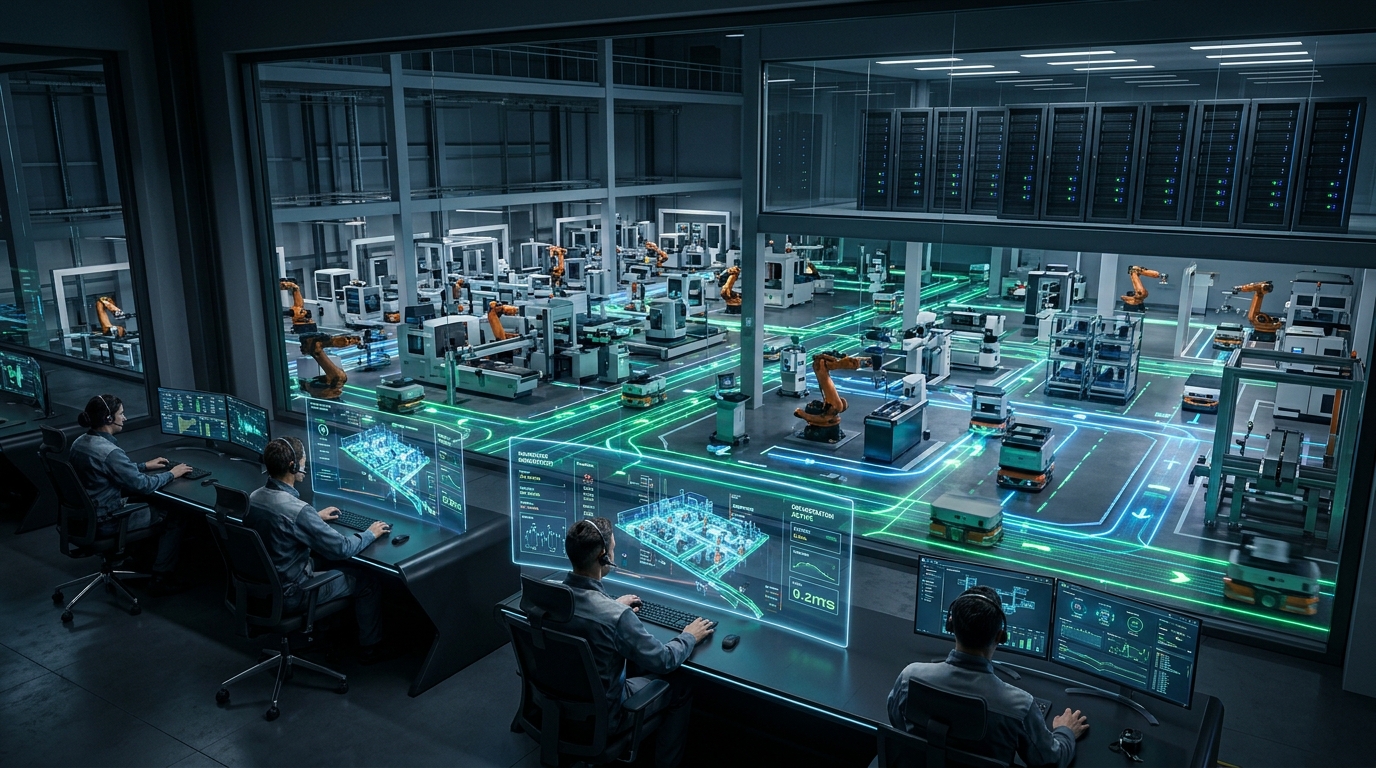
그림 2.2 // 이기종 로봇 플릿의 좌표계 통합 및 시공간 경로 예약을 수행하는 넥사 OS 통합 관제 아키텍처GOOGLE IMAGEN 3 • 4K ASSET
기업들이 로봇 하드웨어 도입비로 5억 원을 지출할 때, 정작 향후 3년간 눈에 보이지 않게 증발하는 소프트웨어 통합 및 운영 매몰 비용은 평균 17억 원(3.4배)에 달합니다. 현장에서 돈을 태우는 3대 주범은 다음과 같습니다:
첫째, 1회용 SI 글루 코드(Glue Code) 외주 개발비의 반복 증발: 새 제조사 로봇이 하나 들어올 때마다 SI 엔지니어들이 3~6개월간 상주하며 상위 WMS/ERP와 로봇 제조사 API를 1:1로 하드코딩합니다. 하지만 로봇 펌웨어가 한 번만 업데이트되거나 타사 로봇이 추가되면 기존 코드는 재사용성 0%의 쓰레기가 되어 처음부터 다시 짜야 합니다.
둘째, 복도 교차로 데드락(Deadlock)으로 인한 택트타임 붕괴: 폭 2.2m 복도에서 서로 다른 제조사 로봇 두 대가 마주치면, 각자의 안전 센서(ISO 3691-4)가 작동해 급정거한 뒤 상대방이 비키기만을 무한정 기다립니다. 결국 수십억 원을 들인 무인 공장에서 현장 작업자가 달려가 손으로 로봇을 밀어내는 촌극이 매일 벌어집니다.
셋째, 승강기·자동문·방화셔터 중복 공사와 신호 충돌: A사 로봇용 엘리베이터 통신 모듈, B사 로봇용 통신 모듈을 승강기 제어반(PLC)에 덕지덕지 중복 설치하느라 대당 수천만 원의 부대 공사비가 날아갑니다. 심지어 두 로봇이 동시에 문을 열라고 명령을 보내면 승강기 제어반이 에러를 뿜으며 멈춰 섭니다.
3. 도입 의사결정권자(CTO·물류총괄)를 위한 3대 생존 체크리스트
📌 다종 로봇 도입 전 반드시 확인해야 할 아키텍처 검증 질문
✓ 질문 1 (좌표계 정합): 서로 다른 SLAM 방식(2D 라이다, 3D 비전)을 쓰는 이종 로봇들의 지도를 단 하나의 글로벌 디지털 트윈 좌표계로 실시간 변환할 수 있는가?
✓ 질문 2 (시공간 예약): 교차로에서 충돌이 난 뒤 멈추는 사후 대응이 아니라, 30초 후의 동선 겹침을 미리 계산해 시공간(Time-Space) 슬롯을 예약하는 커널 스케줄러가 있는가?
✓ 질문 3 (무코드 어댑터): 향후 새로운 제조사의 로봇이나 휴머노이드를 추가할 때, 기존 SI 코드를 뜯어고치지 않고 플러그앤플레이(Plug-and-Play)로 즉시 인식하는가?
4. 넥사 OS(NEXA OS)의 해답: 1회용 SI가 아닌 '영구적 운영체제 커널'
우리가 넥사 OS를 밑바닥부터 설계하고 있는 이유는 명확합니다. 로봇 대수가 늘어날수록 통합 비용이 제곱($N^2$)으로 폭발하는 기형적인 SI 구조를 끝내려면, 윈도우(Windows)가 수만 종의 프린터와 마우스를 표준 드라이버로 묶었듯 모든 로봇 하드웨어를 추상화하는 단일 운영체제 커널이 존재해야만 합니다. 내일 Day 03 칼럼에서는 연구실에서 찬양받는 오픈소스 ROS2가 왜 3교대 미션 크리티컬 제조 현장에서는 결정론(Determinism) 한계로 무너지는지 그 아키텍처적 진실을 해부하겠습니다.
SERIES: NEXA 64-Day Engineering Master Plan (Day 02/64)•AUTHOR: NEXA Labs Architecture Team
ROBOTICS INDUSTRY & OS VALUE
BILINGUAL FORMAT: ENGLISH • 한국어 병기
schedule 8 MIN READ • OCT 27, 2026
2040 Industry Thesis: In the Era of 10 Billion Robots, Why the Operating System (OS)—Not Hardware—Captures Real Value
2040년 100억 대 로봇 시대의 산업 분석: 왜 하드웨어가 아닌 '운영체제(OS)'가 투자 가치의 핵심인가
language Part 1: Strategic Industry Analysis (English)
1. The Commoditization of Robot Hardware
Every historical computing cycle reveals the exact same inflection point: initially, hardware innovations drive excitement, but as mechanical components mature, hardware margins inevitably compress toward single digits. In mobile computing, hardware became commoditized while Android and iOS captured the platform value. The global robotics industry is entering this precise transition today.
2. The Disconnect: 500 Deployments and the $2M Integration Trap
Having deployed over 500 commercial robots in complex real-world facilities, our team learned the hard truth firsthand: buying robots is cheap; making them work together without constant human intervention is catastrophically expensive. When an enterprise deploys three different brands of AMRs and robotic arms, they are forced to spend up to 10x the robot cost on custom SI glue code that breaks on the next firmware update.
This fundamental mismatch is why we decided to build NEXA OS. We are not a finished product resting on laurels; we have just initiated our core kernel development. Our goal is straightforward: create a hardware-agnostic, deterministic operating layer that allows multi-vendor robots to coordinate in real time. We are building in public over the next 64 days toward CES 2027.
translate Part 2: 공식 기술 분석 및 국문 해설
1. 하드웨어 치킨게임의 종말과 플랫폼의 태동
모터, 감속기, 라이다, 센서 등 로봇 하드웨어의 스펙은 이미 전 세계적으로 상향 평준화되고 있습니다. PC 산업에서 하드웨어 조립사들의 마진이 급감하고 윈도우(Windows)가 생태계를 장악했듯이, 그리고 스마트폰에서 안드로이드와 iOS가 가치를 독점했듯이, 2040년 100억 대 로봇 시대의 헤게모니는 로봇을 '조립'하는 제조사가 아니라 서로 다른 로봇을 '연결하고 조율'하는 **운영체제(OS)**에 있습니다.
2. 500대 실전 납품에서 배운 뼈아픈 교훈: "로봇보다 통합 비용이 10배 더 든다"
실제 산업 현장에 500대 이상의 로봇을 공급하며 날린 수많은 시간과 비용이 증명한 명백한 사실이 있습니다. 기업들은 1대당 3천만 원짜리 로봇을 사는 데는 망설이지 않지만, 서로 다른 제조사의 로봇들이 복도에서 마주쳐 얼어붙고 관제 소프트웨어가 따로 노는 문제를 해결하느라 수억 원의 SI 통합 비용과 매몰 비용을 허비합니다.
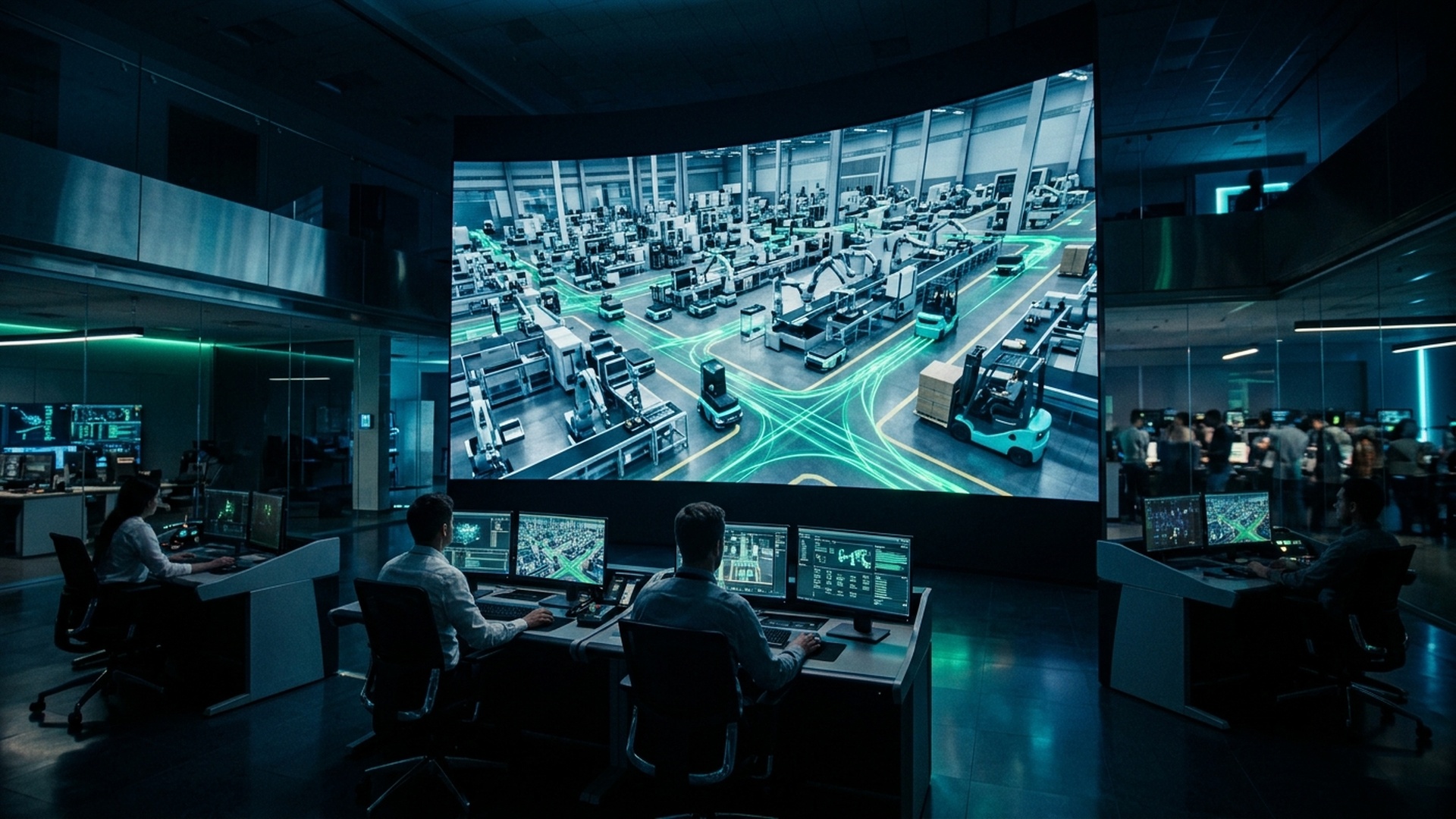
그림 1.2 // 넥사 OS 단일 커널 기반의 실시간 통합 로보틱스 오케스트레이션 비전4K INLINE ASSET
3. 넥사 OS(NEXA OS): 밑바닥부터 시작하는 출사표
이것이 우리가 완성품이라는 거짓 포장 대신, "로보틱스 윈도우를 만들겠다"는 목표로 이제 막 넥사 OS의 기초 코드를 짜기 시작한 이유입니다. 우리는 앞으로 64일간의 개발 여정 동안, 매일 현장에서 겪는 실패와 디버깅, 아키텍처 설계를 가감 없이 공유하며 CES 2027을 향해 달려가겠습니다.
Try resetting the keyword filter or selecting “All Categories”
EXPLORE NEXA
From Engineering Insights to Real-World Robotics
Discover how NEXA approaches the operational challenges of connecting, controlling, and orchestrating heterogeneous robotic systems at industrial scale.